©PCCL GmbH

Ein interdisziplinäres Forschungsteam der Montanuniversität Leoben hat gemeinsam mit der Technischen Universität Graz und dem Polymer Competence Center Leoben GmbH eine neue Strategie zur Funktionalisierung dynamischer Polymernetzwerke entwickelt. Die Ergebnisse wurden kürzlich in der renomierten Fachzeitschrift Angewandte Chemie International Edition veröffentlicht.

Read more

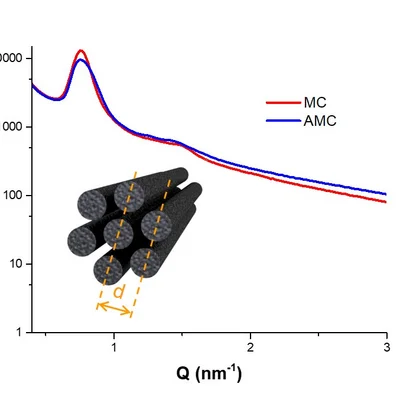
In a new paper published in ACS Applied Materials & Interfaces, we introduced in situ anomalous small-angle X-ray scattering (ASAXS) as a unique method to extract both real-time structural and ion-specific chemical information from one single experiment.

Read more

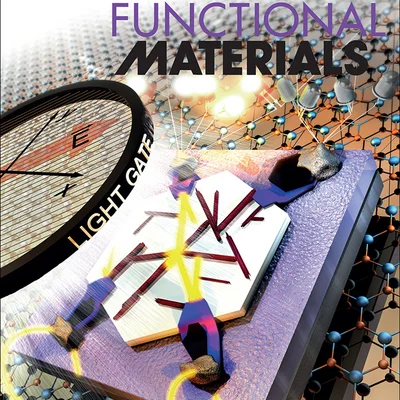
Our recent publication on 2D materials/organic semiconductors hybrid heterostructures is featured as an inside-back cover of Advanced Functional Materials, Volume29, Issue43.

Read more

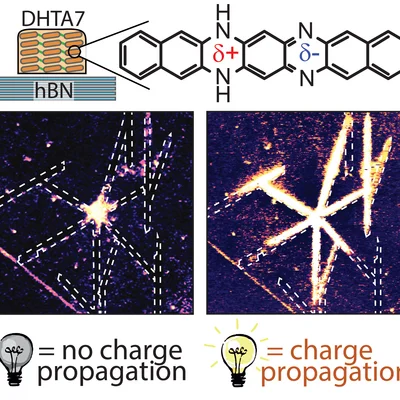
A consortium between Institute of Physics Montanuniversität Leoben, Aix Marseille University, and Karl-Franzens-Universität Graz demonstrated for the first time light- and polarization-controlled charge propagation and switching between nonconductive and conductive states in networks of self-assembled and self-aligned organic nanostructures on hexagonal boron nitride.

Read more

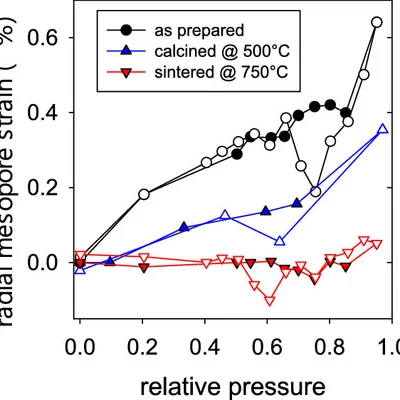
Using In Situ Small-Angle Neutron Scattering while adsorbing a zero scattering length density adsorbate allowed us to quantitatively measure adsorption-induced deformation of ordered meso-/microporous materials.

Read more

The electrochemical Performance of a supercapacitor strongly depends on the pore structure of the electrode material. We have investigated the influence of the mesopore structure on the capacitance for elevated charging and discharging rates.

Read more

New paper published in Carbon: From real space pore structures, derived from small-angle X-ray scattering, a pore size distribution of activated carbon materials was calculated and compared to results obtained from gas sorption analysis. Additionally, it was shown that the often used slit pore assumption narrows the actual pore size distribution.

Read more

The use of hexagonal boron nitride (hBN) as ultra-smooth, weakly interacting van der Waals substrate for organic thin film growth and self-organization is an active area of research. hBN effectively decouples the adsorbed species from the support making intrinsic material’s properties visible which would otherwise be masked by the strong surface-adsorbate interaction. Thus, new insights in fundamental aspects of intermolecular interaction, self-assembly, electronic structure or chemical reactions are possible.

Read more

In cooperation with scientists of the National Academy of Sciences of the Ukraine and Slovakia we have demonstrated that differently doped atomic force microscopy probes can be used a submicrometer electrodes to probe and discriminate different semiconductor domains in CdS/Kesterite bulk heterojunction solar cells.

Read more

Scientists of the Material Center Leoben, the Department of Material Physics of the Montanuniversitaet Leoben, and Gerhard Popovski of the Institute of Physics have shown that different copper surfaces will influence the growth of copper oxide nanowires. Small copper grains and high surface roughness promote the growth of these important structures, which are used for example in solar cells or sensors.

Read more